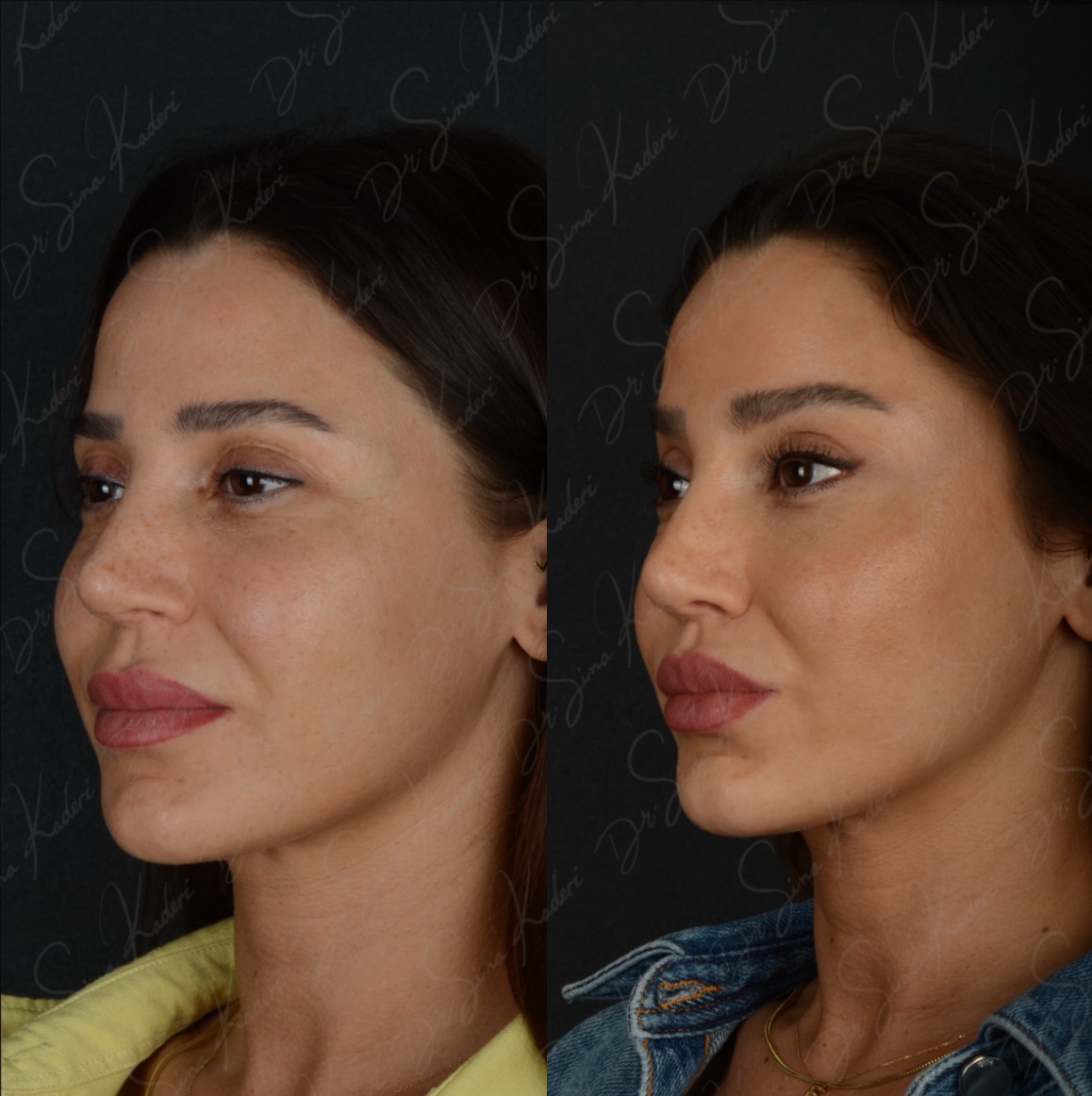
Lip Lift vs. Extended Lip Lift: Differences, Techniques & Benefits
Lip Lift vs. Extended Lip Lift: What Are the Differences and Which Technique Is Better?
Is shortening the skin enough to achieve an aesthetically pleasing upper lip, or should the underlying muscle structure also be reshaped?
One of the fundamental principles of facial aesthetic surgery is that natural and balanced results require more than simply modifying the skin. The underlying anatomical structures must also be carefully evaluated.
The same principle applies to lip aesthetics.
A Lip Lift is a surgical procedure designed to shorten the distance between the base of the nose and the upper lip, improving lip position, visibility, and overall facial proportions.
However, not all Lip Lift procedures are performed using the same surgical technique.
The main difference between a Traditional Lip Lift and an Extended Lip Lift lies in the extent of surgical intervention and how the anatomical structures supporting the upper lip are addressed.
So, what distinguishes these two techniques? Why was the Extended Lip Lift developed, and which patients may benefit from this approach?
What Is a Lip Lift?
A Lip Lift is a surgical procedure that reduces the distance between the base of the nose and the upper lip, commonly referred to as the philtrum.
In facial aesthetics, upper lip length influences not only the appearance of the lips but also the overall balance between the nose, mouth, and chin.
In individuals with an elongated upper lip, several aesthetic characteristics may be observed:
- The upper lip may appear thinner than it actually is.
- The pink portion of the lip, known as the vermilion, may be less visible.
- Upper incisor visibility at rest may be reduced.
- The distance between the nose and mouth may appear disproportionate.
- The lower facial region may appear elongated or show signs of aging.
The purpose of Lip Lift surgery is not simply to elevate the upper lip but to reposition it in harmony with the surrounding facial structures.
How Is a Traditional Lip Lift (Bullhorn Lip Lift) Performed?
The traditional Lip Lift, often called the Bullhorn Lip Lift, is one of the most commonly performed upper lip lifting procedures.
During this operation, an incision is designed along the natural contours of the nasal base. The incision resembles the shape of bull horns, giving the technique its name.
A predetermined amount of skin is removed, and the upper lip is advanced upward before the incision is closed.
This shortens the distance between the nose and upper lip and may increase the visibility of the upper lip vermilion.
In traditional skin-excision techniques, the surgical intervention primarily focuses on the skin.
However, an important anatomical structure lies beneath this area: the orbicularis oris muscle.
Why Is the Orbicularis Oris Muscle Important?
The orbicularis oris is one of the primary muscles responsible for lip movement.
It plays an essential role in speaking, smiling, pursing the lips, and performing numerous facial expressions.
Therefore, the upper lip is not simply a static layer of skin. It is a dynamic anatomical structure consisting of skin, muscle, and surrounding soft tissues.
In skin-only Lip Lift techniques, insufficient support from the underlying tissues may contribute to increased tension along the incision in certain patients.
Potential consequences may include:
- Widening of the surgical scar
- Increased tension along the incision
- Undesirable changes in lip contour
- Partial reduction of the lifting effect over time
These complications do not occur in every traditional Lip Lift procedure. Outcomes depend on surgical technique, tissue characteristics, wound closure, and individual healing.
Nevertheless, this raises an important surgical question:
When repositioning the upper lip, should we modify only the skin, or should we also consider the muscle responsible for lip movement?
What Is an Extended Lip Lift?
An Extended Lip Lift is a more comprehensive modification of traditional upper lip lifting surgery.
The term Extended Lip Lift is used to describe different surgical modifications. Some involve extending the incision laterally, while others incorporate additional soft-tissue or muscular adjustments.
In my surgical approach, one of the key principles is evaluating and, when appropriate, reshaping the orbicularis oris muscle in addition to removing excess skin.
The objective is not merely to shorten the distance between the nose and upper lip.
It is also to provide structural support for the new lip position, preserve a natural lip contour, and minimize unnecessary tension along the incision.
1. Addressing Both the Skin and the Underlying Muscle
One of the important characteristics of my Extended Lip Lift approach is the potential incorporation of orbicularis oris muscle remodeling.
During this stage, the muscle may be carefully repositioned or reshaped according to the patient's anatomy and the desired lip position.
The objective is to create additional structural support rather than relying exclusively on skin closure to maintain the lifting effect.
2. Reducing Tension Along the Surgical Incision
One of the most common concerns among patients considering Lip Lift surgery is the visibility of the postoperative scar.
In traditional techniques, excessive tension along the skin closure may contribute to scar widening or more noticeable scarring.
In my Extended Lip Lift approach, deeper tissue support is incorporated when appropriate to help distribute tension away from the superficial incision.
This may contribute to more controlled wound healing.
However, Extended Lip Lift is not a scarless procedure. Final scar quality depends on several factors, including skin characteristics, genetics, surgical technique, and postoperative care.
3. Supporting the Long-Term Lip Position
Skin naturally undergoes changes in elasticity over time. In addition, the upper lip is continuously involved in facial movements such as speaking and smiling.
For this reason, maintaining the new lip position solely through skin closure may not be ideal for every patient.
By incorporating deeper anatomical structures into the surgical plan, Extended Lip Lift aims to provide additional support for the repositioned upper lip.
Nevertheless, current scientific evidence is insufficient to conclude that Extended Lip Lift consistently offers superior long-term durability compared with traditional techniques.
4. Creating a More Balanced Upper Lip Contour
A successful Lip Lift is not about lifting the upper lip as much as possible.
Instead, the goal is to maintain harmony between the central lip, lateral lip segments, and oral commissures.
Excessive elevation of the central upper lip may create an unnatural appearance or distort the normal lip contour.
In Extended Lip Lift planning, the amount and distribution of elevation are individually determined according to the patient's anatomy.
The objective is to achieve a well-defined, aesthetically balanced, and natural-looking upper lip, without excessive elevation.
Traditional Lip Lift vs. Extended Lip Lift: Key Differences
FeatureTraditional Lip LiftExtended Lip Lift
Surgical approach | Primarily shortens the upper lip skin | May involve skin and deeper tissue remodeling
Orbicularis oris muscle | Usually preserved in skin-only techniques | May be reshaped when indicated
Incision tension | Depends on closure technique | Deeper support may help reduce superficial tension
Lip contour | Elevates the upper lip and improves vermilion show | Allows more comprehensive contour planning
Scar quality | Depends on surgical technique and healing | Tension management may offer advantages
Long-term results | Produces a lasting anatomical change | Aims to provide additional structural support
Both techniques can achieve successful results in appropriately selected patients.
It would not be accurate to suggest that Extended Lip Lift is automatically superior for every patient.
Who May Be a Good Candidate for an Extended Lip Lift?
Extended Lip Lift may be considered in patients with the following characteristics.
Patients with an elongated philtrum: Shortening the distance between the nose and upper lip may improve facial proportions.
Patients with a thin-looking upper lip: The procedure may increase the visibility of existing lip tissue without necessarily adding volume through fillers.
Patients with reduced upper incisor visibility: The amount of upper tooth show at rest can be evaluated when planning the degree of elevation.
Patients requiring more extensive lip contour adjustment: A broader surgical approach may be considered when both the central and lateral portions of the upper lip require attention.
Patients with age-related upper lip elongation: Age-related changes in skin elasticity and lip anatomy may be addressed through individualized surgical planning.
However, not every patient with a relatively long upper lip requires surgical shortening. Dental position, maxillary anatomy, lip closure, and overall facial proportions must be considered before surgery.
Why Is Millimeter-Level Planning Essential in Lip Lift Surgery?
In facial aesthetic surgery, changes of only a few millimeters can significantly influence facial expression.
This is particularly true in the upper lip region.
The distance between the nasal base and upper lip is relatively small, meaning even subtle adjustments can produce visible changes.
For this reason, surgical planning should not be based solely on measuring philtrum length.
Other important considerations include:
- Upper lip vermilion height
- Upper incisor visibility at rest
- Lip movement during smiling
- Position of the oral commissures
- Nasal base anatomy
- Overall facial proportions
The ideal Lip Lift is not the procedure in which the greatest amount of skin is removed, but the one in which the correct amount of tissue is repositioned within the appropriate anatomical planes.
Excessive elevation may lead to difficulty closing the lips, excessive tooth show, or an unnatural upper lip appearance.
Ultimately, surgical success depends not only on the selected technique but also on precise, patient-specific planning.
Does Extended Lip Lift Leave a Scar?
Like any surgical procedure involving an incision, Lip Lift surgery leaves a scar.
The incision is generally positioned along the natural anatomical boundaries of the nasal base to make it as inconspicuous as possible.
In my Extended Lip Lift approach, muscle and deeper tissue support may be used to help reduce tension along the skin closure.
However, visible scarring cannot be completely prevented.
During the early healing period, redness, firmness, and swelling may be present.
In most patients, the scar gradually becomes less noticeable over the following months. Final scar maturation generally takes approximately 6–12 months and may take longer in some individuals.
Extended Lip Lift Recovery Timeline
Recovery varies according to the surgical technique, individual anatomy, and healing characteristics.
Days 1–3: Swelling, tightness, and mild bruising around the upper lip are common.
Days 7–10: Swelling generally begins to decrease significantly. Many patients can gradually return to their normal social activities.
First month: The upper lip contour becomes more natural as swelling subsides.
Months 3–6: Scar redness and tissue firmness usually continue to improve.
Months 6–12: Scar maturation and subtle changes in lip contour may continue.
During early recovery, patients should avoid excessive stretching of the upper lip, follow wound-care instructions carefully, and protect the incision from sun exposure.
Lip Lift vs. Lip Fillers: What Is the Difference?
Lip Lift surgery and injectable lip fillers address different anatomical concerns.
Lip fillers primarily increase lip volume and may modify specific aspects of the lip contour.
A Lip Lift, on the other hand, changes the anatomical position of the upper lip and shortens the distance between the nose and mouth.
For example, in a patient with a long upper lip but adequate natural lip volume, simply adding filler may not correct the underlying anatomical concern.
In some cases, excessive filler may even make the upper lip appear heavier or more projected.
Therefore, before selecting a treatment, it is essential to determine whether the main concern involves insufficient lip volume or the anatomical position and proportions of the upper lip.
Is Extended Lip Lift Suitable for Everyone?
No.
Patients who already have a short upper lip, excessive upper tooth visibility at rest, or borderline lip closure may not be suitable candidates for Lip Lift surgery.
Other factors that require consideration include nasal base anatomy, previous procedures, existing scars, smoking, and medical conditions that may affect wound healing.
Potential complications include asymmetry, noticeable scarring, infection, sensory changes, undesirable lip contour changes, and over-shortening of the upper lip.
This is why applying the same amount of skin excision or muscle remodeling to every patient would not be appropriate.
Every operation should be customized according to individual anatomy and aesthetic goals.
Conclusion: Successful Lip Lift Surgery Begins With Understanding Anatomy
Lip Lift surgery should be approached as more than a simple skin-removal procedure.
A traditional Lip Lift can effectively shorten the upper lip in properly selected patients.
Extended Lip Lift offers a more comprehensive anatomical approach in selected cases by incorporating additional soft-tissue adjustments and, when appropriate, orbicularis oris muscle remodeling.
In my surgical philosophy, the goal is not simply to create a more elevated upper lip.
Instead, I aim to evaluate the position, shape, structural support, and overall proportions of the lips in relation to the entire face.
Because successful lip aesthetics are not defined by how much tissue is removed, but by how well the natural anatomical harmony of the face is preserved.
Op. Dr. Sina Kaderi
Plastic, Reconstructive and Aesthetic Surgeon
Istanbul, Turkey